Publications & Manuscripts
Research
Published work and manuscripts under review across indoor localization, signal modeling, simulation, and applied machine learning.
Journal Publications
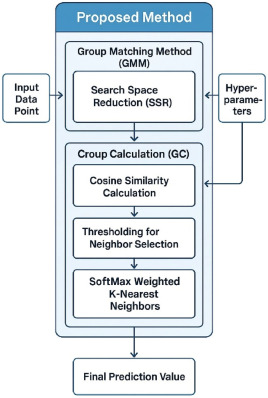
This paper proposes Query-Adaptive Local Regression (QALR), a query-specific regression framework for high-dimensional spectral analysis where the number of variables exceeds the number of labeled training samples (p > n). The method combines search-space reduction with Softmax-weighted nearest-neighbor regression to improve prediction accuracy and inference efficiency.
Li, S., Lin, H., & Peng, W. (2026). Query-Adaptive Local Regression for High Dimensional Spectral Analysis. Chemometrics and Intelligent Laboratory Systems, 105800.
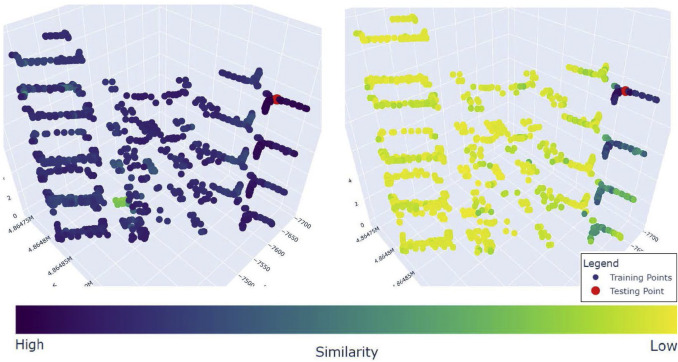
This paper proposes GMM-TSFA, an enhanced machine learning framework that combines fingerprint transformation, similarity-based filtering, and adaptive reference selection. It improves localization accuracy and robustness while maintaining an interpretable decision process.
Lin, H., Li, S., Peng, W., & Peng, A. (2026). An enhanced group matching method with transformed fingerprints, similarity filtering, and adaptive selection for indoor localization. Internet of Things, 101866.
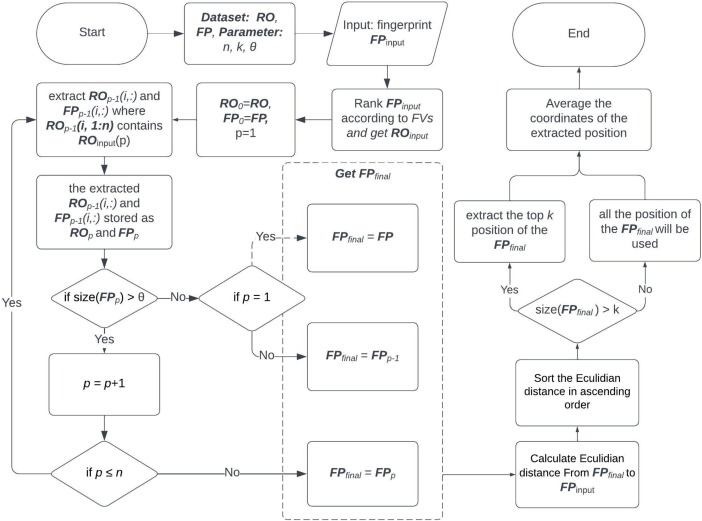
This paper proposes the Group Matching Method (GMM), an interpretable RSS fingerprint matching framework for indoor localization. The method reduces irrelevant training samples before inference, improving localization accuracy and computational efficiency while maintaining model transparency.
Lin, H., Li, S., & Peng, W. (2025). Group matching method for search-space reduction, development, proof, and comparison. Expert Systems with Applications, 270, 126547.
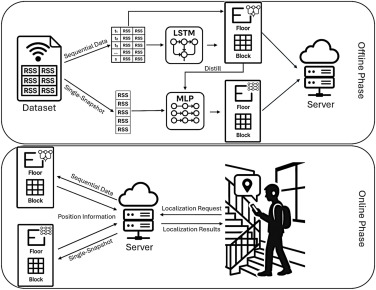
This paper proposes a dual-mode learning framework that combines sequence modeling with LSTM and lightweight inference using a distilled MLP. The framework supports both temporal RSS sequences and single-snapshot inputs for efficient real-time indoor localization.
Lin, H., Chen, Y., Li, S., & Peng, W. (2025). A dual-mode framework for indoor localization via temporal learning and knowledge distillation. Ad Hoc Networks, 104089.
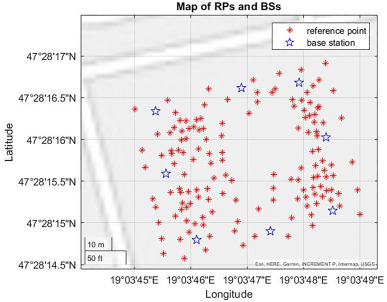
Two-stage clustering for improve indoor positioning accuracy
This paper proposes TSCA, a two-stage clustering-based indoor positioning method for complex indoor fingerprint datasets. It first uses the Group Matching Method to divide RSRP data into meaningful groups, then applies positioning within the selected group to improve accuracy.
Lin, H., Purmehdi, H., Fei, X., Zhao, Y., Isac, A., Louafi, H., & Peng, W. (2023). Two-stage clustering for improve indoor positioning accuracy. Automation in Construction, 154, 104981.
Conference Publications
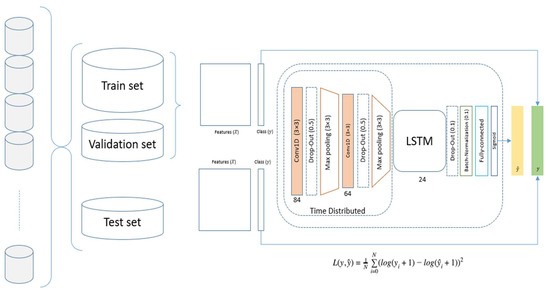
A novel SFDN+ DNN approach for efficient hand movement recognition using surface electromyography signals
This paper proposes an SFDN+DNN approach for sEMG-based hand movement recognition. By cleaning and normalizing sEMG signals before DNN classification, the method achieves high accuracy across multiple public datasets.
Khorram, A., Lin, H., & Peng, W. (2024). A novel SFDN+ DNN approach for efficient hand movement recognition using surface electromyography signals. Engineering Proceedings, 76(1), 52.
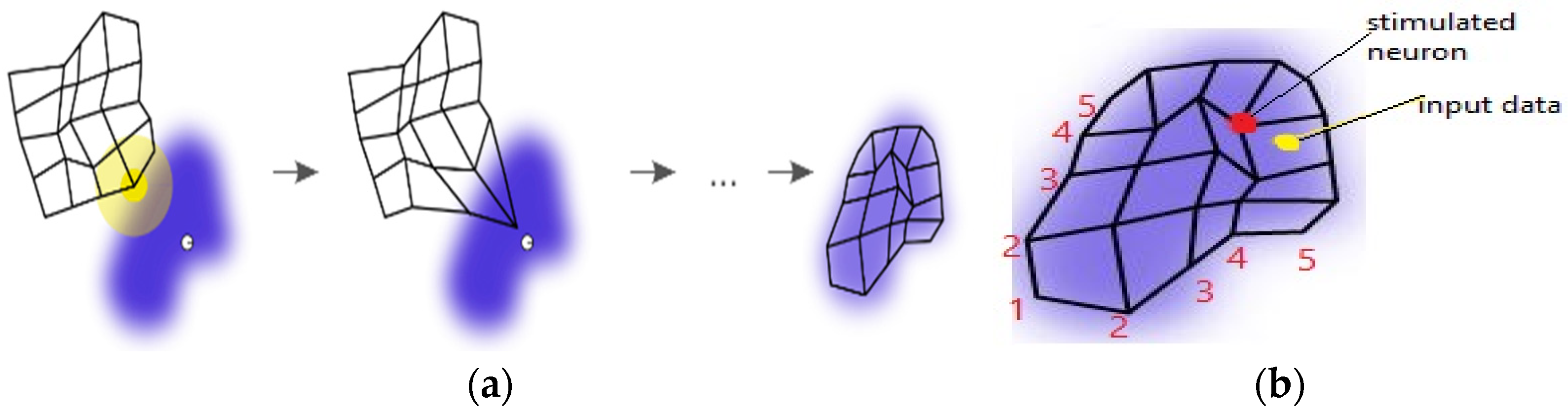
A Self-Organizing Map Artificial Neural Network for Breast Cancers
This paper applies a Self-Organizing Map neural network to improve clustering and pattern discovery for breast cancer classification data. The study demonstrates how unsupervised learning can support biomedical data analysis and visualization.
Nakhaeepishkesh, M., Peng, W., & Lin, H. (2024). A Self-Organizing Map artificial neural network to improve the K-means algorithm on the classification of different cancers. Engineering Proceedings, 76(1), 67.
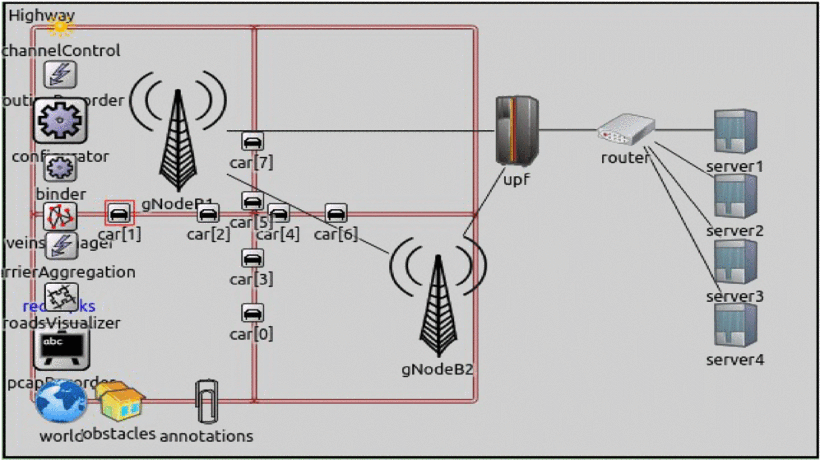
Simulation of NR-V2X in a 5G Environment using OMNeT++
This paper proposes a 5G NR-V2X simulation framework to generate traffic data for network traffic prediction research. Using OMNeT++, INET, Simu5G, and Veins, it evaluates uplink performance in V2N scenarios.
Pusapati, S., Selim, B., Nie, Y., Lin, H., & Peng, W. (2022). Simulation of NR-V2X in a 5G environment using OMNeT++. In 2022 IEEE Future Networks World Forum (FNWF) (pp. 634-638). IEEE.
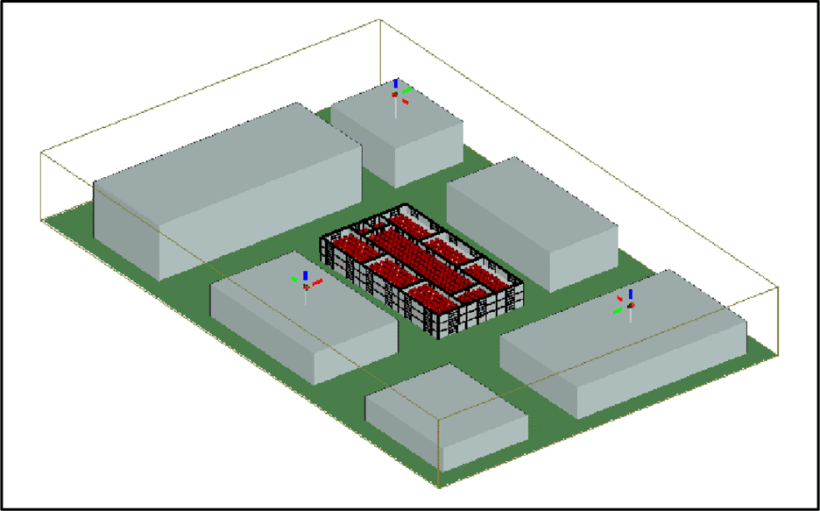
This paper presents a 3D ray-tracing-based simulation framework for generating near-realistic 5G MIMO fingerprint datasets. The generated data supports machine learning model training and evaluation for indoor positioning tasks.
Lin, H., Purmehdi, H., Zhao, Y., & Peng, W. (2022). Building 5G fingerprint datasets for accurate indoor positioning. In 2022 IEEE Future Networks World Forum (FNWF) (pp. 203-208). IEEE.
Under Review
A prior-probability-driven structured attention network for indoor localization
Structured attention network for indoor localization. The manuscript is currently under review.
Exploring sampling parameters and localization performance in a multi-layer, multi-structure 5G environment
Study of sampling parameters and localization performance in 5G environments. The manuscript is currently under review.